


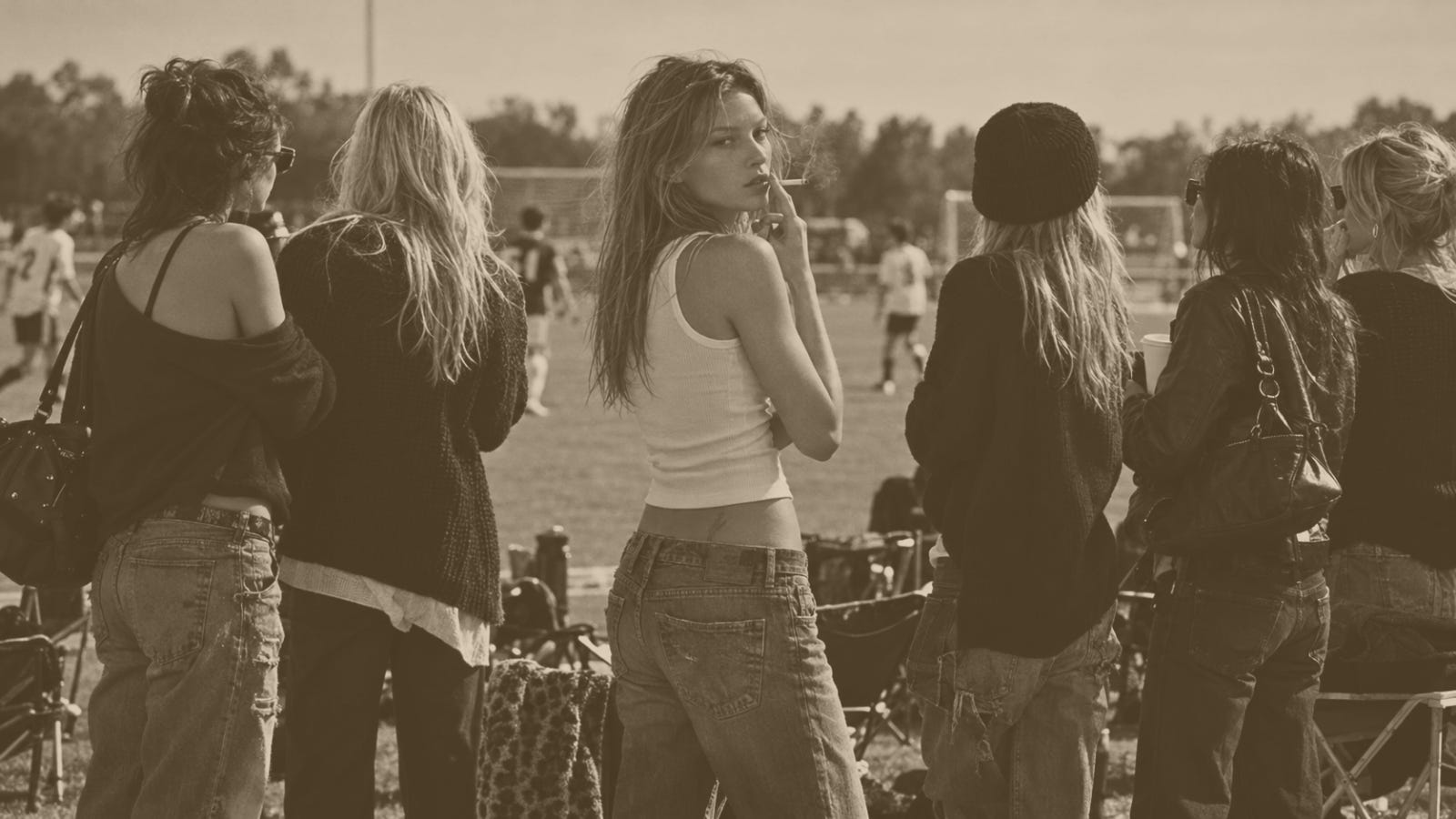
Kinda Chic. Another regurgitated buzz phrase repackaged as original.
An online aesthetic and persona built around looking effortlessly cool. A little undone and a little imperfect. You know it, that carefully curated nonchalance vibe that takes considerable effort to achieve.
Kinda chic pretends to stand against something, but in reality, it is a carbon copy of whatever the algorithm is telling everyone to do.
There’s nothing chic about kinda chic.
At today’s pace, trends are copied, saturated, bastardized, and turned into a dad joke in under a week.
A trendy thing to say right now is that taste is the future. The funny thing about good taste is it’s usually the opposite of trendy.
And therein lies the challenge.
Taste is extremely difficult to scale. And in a capitalist economy obsessed with growth, that poses a problem.
Even though I’ve been known to say scale is where quality goes to die, I’m not pretending scale or monopolization is going anywhere. In fact, I think this global Amazon effect will only grow stronger in our day to day lives.
Which brings me to another trending buzz phrase: Anti Trend.
The idea is simple enough. Qualities that live outside the churn of fast fashion, mass adoption, and algorithmic sameness get positioned as Anti Trend.
But an Anti Trend approach isn’t about saying you are different. It’s about actually living differently. And there is a difference.
Cue the contradiction.
Anti Trend is now trending. The rebellion itself has become the trend.
But I’m okay with it.
In 2026, we’re finally seeing brands embrace defiance and nonconformity once again. Similar to the grunge wave of the early 90s, rebellion is back in style.
Less pretense. Less polish. More substance. More grit.
I’m all for it. The last decade has leveraged essentially the same playbook with a different set of Pantones. And people are tired. I’m tired.
The grunge movement of the early 1990s was more than a musical movement. It was a cultural correction. A rebellion against the consumption, commercialization, and manufactured perfection of the 80s.
It rejected what mainstream culture had become, trading perfection for an unapologetic embrace of imperfection.
In the right circles, you can feel something similar happening again. A noticeable fatigue with the hyper curated, beige aesthetic. Music, film, fashion, sports campaigns, even wellness brands are beginning to reflect it.
Where the early 1980s celebrated aspiration and success, grunge gave voice to skepticism, anxiety, and frustration, particularly among Generation X, a generation that in many ways looks a lot like Gen Z today.
Grunge wasn’t simply a new genre of music. It spawned a rebellious counterculture. A classic case of cause and effect.
Gen X: You sold us the polished American Dream. We don’t believe you.
Gen Z: You sold us the optimized digital version of life. We don’t believe you.
Perhaps the greatest irony was that the moment grunge became commercially successful, the industry began packaging, marketing, and selling the very authenticity that had made it appealing in the first place.
A movement that rejected branding became one of the most recognizable cultural brands of the twentieth century.
And maybe that’s where things get interesting.
If enough people give beige the middle finger, eventually the middle finger becomes a trend too.
Still, I’ll take it.
Back to taste …
Taste is a subjective MoFo and is largely driven by exposure, or lack thereof. It is the byproduct of curiosity and participation, not consumption. Taste was once something you discovered. Now it is something you’re sold.
The music you listened to, the cities you visited, the people you hung around with, and the people you hoped to sleep with. You participated. You chanced things. You took risks. And somewhere along the way, you developed a point of view.
Today, consumers are tasting someone else’s IG feed and trying to convince themselves it is their own.
Enter status …
Status, not to be confused with taste, has become an algorithmic checklist of things to own, restaurants to visit, and trips to book.
And maybe that’s the distinction I’ve been struggling to articulate. Taste and status are not the same thing. In many ways, they are polar opposites.
Status, like scale, requires other people.
Scale needs enough people to want the same thing.
Status needs enough people to agree that the same thing is desirable.
Desirable becomes recognizable. Recognizable eventually becomes repeatable. Repeatable becomes scalable. Scalable becomes ubiquitous.
Ubiquitous, at least to me, is just another shade of beige.
Taste doesn’t require an audience and can exist completely independent of agreement. You can have impeccable taste in something nobody else understands, values, or even recognizes.
Case in point, I love old world, mineral rich red wines. Plenty of people love big, meaty new world Cabs. Neither is right or wrong. It’s simply a matter of taste.
But the moment you’re choosing something because other people will recognize what that choice says about you, you’ve introduced status into the equation.
Still, that doesn’t necessarily make the thing bad.
The restaurant could actually be that incredible. The hotel may very well be that beautiful. The clothes might hug just right. And the destination might actually be worth visiting.
That’s not the rub. The problem is that everybody is being served the same menu.
If said algorithm had a voice, which I’m sure it will soon, it might say:
My job is to force feed you a menu of my choosing, allow you to taste it, and convince you the discovery was your own.
Taste doesn’t require validation.
Status does.
When the same desirable things are being served to everyone, a certain level of sameness becomes inevitable.
Whether you live in a major metropolis or a sleepy suburb, today’s hyper connected world leaves us increasingly bound by one menu.
That is precisely why everyone looks somewhat trendy but strangely identical.
Same shoes. Same pants. Different people.
Maybe this is my Xennial DNA talking, but the way I remember it, school style involved clear silos of individual taste.
How you dressed was deeply personal. It was a way to express yourself.
You had preppie kids, skate kids, and surf kids. Not sure how we had surf kids in Ontario, Canada, but we did. You had goths, punks, later came emos, and everything in between.
You could practically tell what music someone listened to by what they were wearing.
Even the jocks didn’t really have a uniform. At least not where I grew up. We played the same sports but didn’t necessarily dress the same.
Today, I’m lost trying to explain to my 13 year old son that there is more to life than grey sweatpants and a freshly teased Broccoli Crop.
But among older teens and young adults, something else seems to be taking shape.
I recently got back from Spain, and in Barcelona, the shift was hard to miss.
I wouldn’t exactly label it as grunge, per se. More like the angst and attitude of grunge dressed in the early 2000s aesthetic of Indie Sleaze.
Apparently, I’m not the only one seeing it. Earlier this year, Pitchfork founder Ryan Schreiber titled an entire piece “#IndieSleaze Will Never Die,” arguing that five years into its revival, the culture that helped define the 2000s is increasingly defining the 2020s too.
Europe tends to be a few years ahead of North America on these things. And when the shift makes its way across the Atlantic, it usually shows up first in cities like Manhattan, LA, Toronto, and Montreal.
Nirvana tees. Deftones tees. Doc Martens. Low rise jeans. Cigarette in hand. Bras optional.
Quite literally, a walking, talking billboard for rebellion with a nod to the heroin chic queen herself, Kate Moss.
A little less polish. A little more indifference.
You wanna talk kinda chic? Heroin chic has a case.
Of course, if enough people start doing it, that becomes a uniform too.
Again, fine by me.
At least this recycled uniform has some angst and attitude.
Maybe that’s ultimately why I’m willing to accept the contradiction of Anti Trend becoming trendy.
I’d rather live in a culture where people occasionally overcorrect, rebel, dress weird, challenge societal norms, create subcultures, see those subcultures commercialized, and eventually rebel against those too.
I’d still take her over an algorithmically assembled costume masquerading as taste when what it’s really chasing is status.
At least there’s friction and participation.
Taste is personal. Status is social.
Taste is discovered. Status is signaled.
Status may argue, recognizable eventually becomes repeatable and scalable.
Taste might counter, I don’t speak beige.
Eventually, taste gives status and scale the middle finger. And the whole fucking thing starts over again.
Rebellion gets commercialized. Imperfection becomes carefully curated.
So be it.
Brandon Cullen
In search of life’s [im]perfect soundtrack ...