


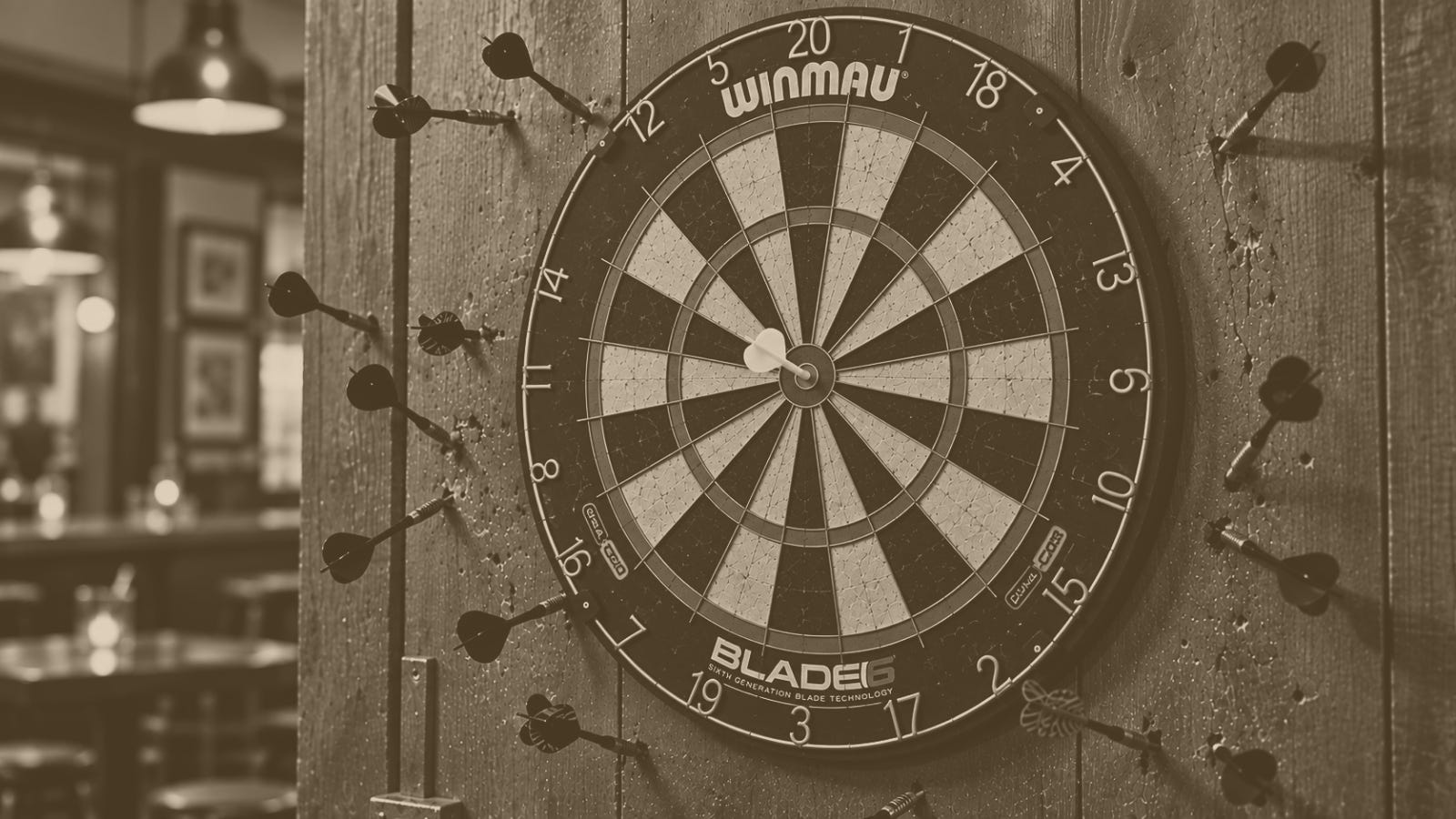
Instead of fighting for the same general customer, a niche narrows the field by defining a specific audience while creating its own set of standards and expectations. It forces you to identify a belief system and then asks you to speak directly to that belief system.
Many brands take a shotgun approach.
A wide-ranging blast designed to hit as much as possible.
To niche is to do the exact opposite.
It trades the shotgun for a sniper rifle.
This calculated approach allows you to focus on a specific target.
Some will argue niching is restrictive. Partly true. But restrictive is not necessarily bad when viewed through a defined scope. It gives you a clear sight line and removes peripheral distractions.
Important to note, a niche concept can’t exist on positioning alone. It needs to show up everywhere. Every single touchpoint should reinforce exactly who the brand is for and, equally important, who exactly it is not designed for.
A friend and colleague of mine, Emma Barry, often labeled “The Oprah of Fitness,” might have said it best in her book Building a Badass Boutique:
“Be single minded in your branding. Be single minded in what your program offers. Be single minded in how your talent delivers the product.”
I’m not saying a general approach won’t work, but in a world with endless choices, there will always be a subset of consumers looking for something more specific. Something that feels like it was built for them rather than adapted to include them.
That’s the real opportunity.
You don’t need everyone.
You need to matter more to someone.
Taking this one step further, I’ve come to think about consumers through two admittedly broad archetypes.
The “I want to be SEEN” consumer and the “I want to BELONG” consumer.
The SEEN consumer wants to know there’s a place for them.
The BELONG consumer wants to know they’ve found their people.
One says, come as you are.
The other says, this is who we are.
Neither is right or wrong and neither is inherently better than the other.
Both present lucrative opportunities. They just require completely different strategies.
Different consumers. Different needs. Different belief systems.
Let me share a personal story here …
A few years back, my business partner Kirk DeWaele and I were asked to consult for another fitness concept. We were even given the opportunity to invest in its future.
At the time, I’d like to think we had built a strong reputation through MADabolic, the cult-like brand we co-founded and built from scratch. A no-nonsense strength and conditioning concept designed to disrupt the boutique space.
Our niche? Strength, structure and accountability. A fitness program built for 25–45-year-old high achievers and ex-athletes who craved more than what the traditional group fitness scene offered.
Our positioning was essentially anti-average and anti-boutique. Everything we did, from the science behind our workouts to our tone, our policies, even our music, was intentionally at odds with much of the industry.
Did it rub some people the wrong way? Absolutely.
But for the high-performing outliers, they had found their people.
The concept we were asked to evaluate was different.
Strike that. The product and consumer were the polar opposite of ours.
Originally designed as an all-women concept, it fundamentally had a niche hardwired in. From what we could tell, it provided a fun and safe environment for first-time female consumers discovering fitness and others rediscovering fitness after a hiatus.
As I said, a very different consumer with very different needs.
So why were the two guys responsible for the DNA of MADabolic being asked to help a company that looked nothing like it?
That’s a great question.
My guess? They needed us to help them become distinctly themselves.
Something we had experience developing.
One of the first questions we asked was simple.
Who is the current customer?
Their answer?
The untrained, overweight female.
Throughout the process, leadership made it clear they believed their existing consumer had handcuffed them to suburban markets. They wanted to pursue more metropolitan sites. They wanted to scale and they wanted a cool factor.
Part of this new direction included a complete rebrand. First, they introduced more gender-neutral Pantones to the branding. Next came a trendier approach to the creative and marketing. Finally, they shifted from all-female to coed classes.
The logic was simple: a women’s-only product reached only 50% of the available market.
In theory, it all made sense.
But there was one problem.
Their new intended consumer had little interest in the product to begin with. Worse, that consumer already had plenty of superior options to choose from.
After Kirk and I toured some of their facilities, evaluated the product, looked at the numbers, and had a series of conversations, we eventually sat down with leadership to present our ideas.
We told them perhaps the biggest issue was that they saw their existing consumer as limiting, or as the primary thing holding them back.
We disagreed.
We saw her as the opportunity.
We stressed that there was, and still is, a substantial pocket of women in this bracket who do not currently speak gym and do not need another trendy fitness concept pretending to be for everyone. What these women needed was something unapologetically specific to them.
What came next kind of shocked them.
We told them to abandon the entire rebrand, including the new color scheme. We told them to abandon the idea of becoming trendier. We told them to abandon the idea of coed classes.
We told them to go back and prioritize the very consumer they were turning their back on.
And we told them our potential investment hinged on it.
We proposed a simplified structure designed to empower this individual, not overwhelm her. Workouts that would build her, not break her. Results gained through repetition and supported by a digestible three-day commitment.
We proposed one low friction membership option: $125 per month with a simple 90 day commitment. A set schedule: Mon/Wed/Fri or Tue/Thu/Sat. The intention was to create camaraderie and accountability through small group silos that trained together regularly. An important step we felt would support the discovery and rediscovery process.
We even proposed a specific approach to music. Something nostalgic, fun and predictable. Our initial thought for the soundtrack was classic hip hop mashups, all day every fucking day!
Biggie & 2Pac
Eminem & Dr. Dre
Missy Elliott & Timbaland
N.E.R.D. & Outkast
Jay-Z & Kanye
Ludacris & Nelly
Just as my friend Emma stressed: single minded and specific.
You get the gist.
Most people know us for an undeniable strength and conditioning concept built for high performers. What some may not know is that we intentionally forged that niche based on what we saw missing in the industry. At no point did we believe that was the only opportunity.
This all-women concept represented an equally compelling niche opportunity. The consumer was the complete opposite of ours, but the same principle applied. Everything we proposed was single minded and specific to her. Predictable and repeatable. An environment that wasn’t intimidating. Simple commitments. And a nostalgic soundtrack.
That’s the power of niche concepts. Two completely different concepts can be equally specific while serving completely opposite physical and psychological needs.
When done right, a niche should attract a specific consumer while repelling the other. That’s the level of specificity that makes a true niche work.
And I still believe it would have worked.
In the end, our proposals were shut down. Leadership chose not to return to their roots.
That jab left a mark.
A company that once had momentum and a defined position is now a fraction of the size.
In pursuit of a larger opportunity, the shotgun approach caused them to lose their audience altogether. Their quest to reach more people ultimately alienated the right people.
Maybe a narrower scope would have generated a bigger bang.
If you pay attention, you’ll notice that when someone describes their love for a product or brand, it’s never about how the brand speaks to everyone. It’s about how the brand speaks to them.
And maybe that is the bigger lesson. Everything can’t be intended for everyone.
Niching isn’t about getting smaller. It’s about getting more specific.
Brandon Cullen
In search of life’s [im]perfect soundtrack ...