


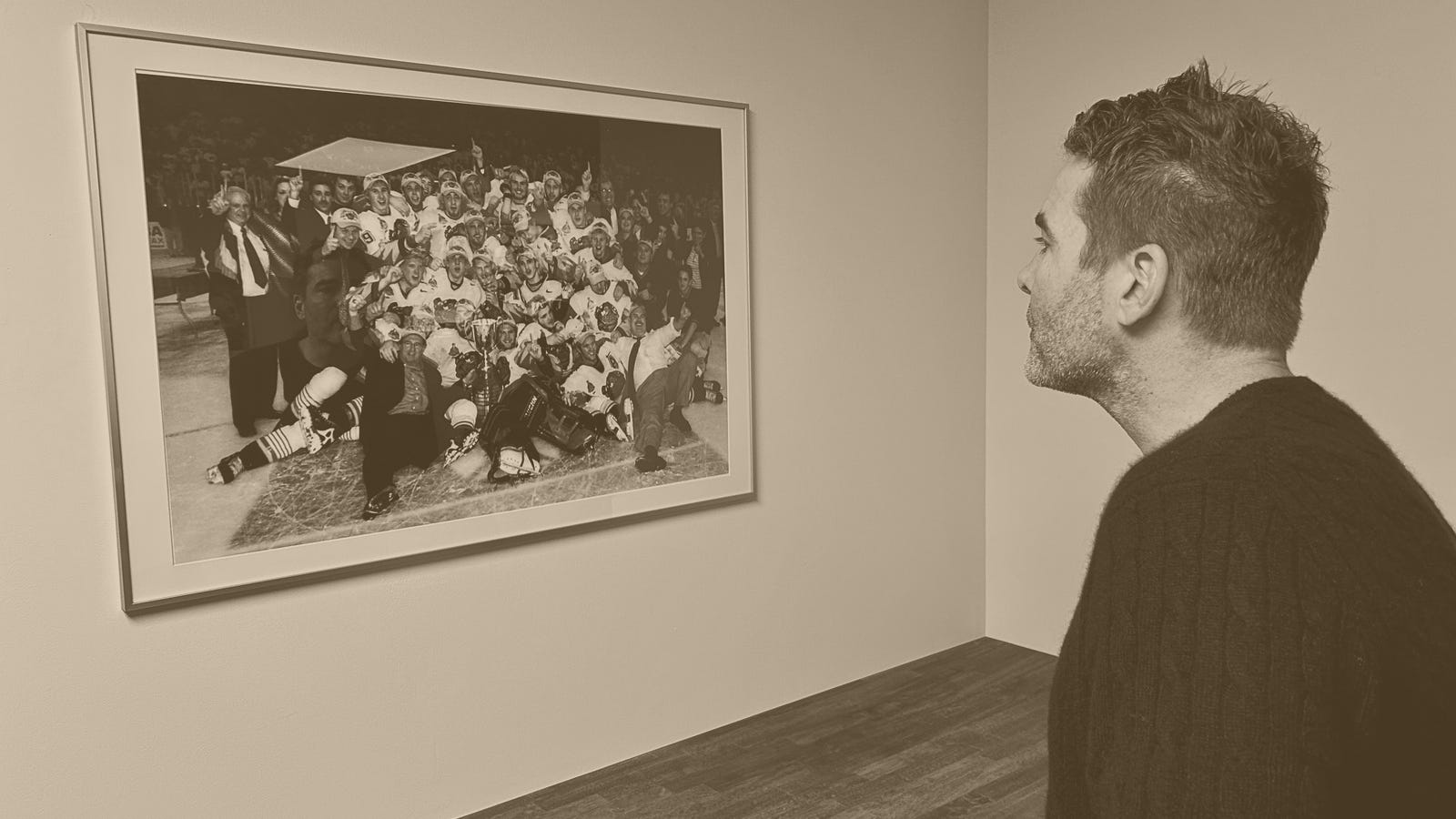
Twenty-five years ago, I was fortunate enough to win a championship with the Erie Otters of the Ontario Hockey League. Recently, the organization invited us back to Erie, Pennsylvania, to celebrate the 25th anniversary of that championship.
Many of us hadn’t seen each other since we went our separate ways in the spring of 2002. Back then, we were just kids. Today, we’re grown men with careers, families, and lives that have taken us in entirely different directions.
Our game has received its share of negative attention in recent years, and in many cases, rightfully so. Some of us were exposed to things that haven’t aged well, and there are issues that deserve to be addressed.
But what often gets lost in that conversation is everything that did age well. The relationships, the discipline, the accountability, and the lasting influence those formative years had on so many of us.
This past weekend was a powerful reminder of just how much good came from that experience.
The familiar faces. The smell of the rink. The genuine smiles of fans who still remember that team. The stories shared between former teammates, coaches, and front office staff. And the realization of just how much that chapter of our lives meant to everyone involved.
Twenty-five years later, I appreciate just how rare an experience that was.
As I thought about what to write for PLYN GLTY this week, I kept coming back to those relationships and the significance of what we’d experienced together.
It reminded me of a TEDx presentation I gave more than a decade ago, one that drew heavily from that particular period of my life. So I went back, pulled up my original notes, and watched the recording.
And I’ve got to admit, watching that younger version of myself was a little uncomfortable.
Not because I disagreed with what I was saying. Quite the opposite.
I saw a less mature entrepreneur who was perhaps a little too eager to be heard and understood. Someone with strong convictions about preparation, discipline, and hard work, but who hadn’t yet accumulated enough life experience to fully appreciate their significance.
I still believe in those things. In fact, I probably believe in them more today.
I just understand them differently.
A Different Kind of Adolescence.
I grew up in Canada, a country full of great humans and ice hockey. Like many Canadian boys, I had a fairly common childhood dream. I wanted to play professional hockey. And as it turned out, I was blessed with just enough ability to chase it.
At 16, like so many of the teammates I’d eventually have in Erie, my family and I faced a decision.
I could stay closer to home, continue playing competitive hockey, and pursue a potential NCAA scholarship. It was a realistic path, one that offered some security and a more conventional route toward an education.
Or I could take a different road.
I’d been drafted into the Canadian Hockey League, widely regarded as one of the best development leagues in the world for hockey players aged 16 to 21 and a potential pathway to the NHL.
Most teams were made up primarily of Canadian players, alongside American standouts and select European prospects. Different backgrounds, but a remarkably similar commitment to the pursuit.
For all of us, there was one significant catch.
At the time, playing major junior hockey meant forfeiting your NCAA eligibility.
Apparently, the $42 a month we received was considered enough compensation to make us professionals in the eyes of the NCAA.
Bullshit, right?
Fortunately, those rules have since changed, giving today’s players opportunities that weren’t available to my generation.
But back then, the decision was fairly straightforward. At least for me, anyway.
I packed up my purple Z22 Cavalier and went chasing a dream.
Major junior hockey has a way of forcing you to grow up quickly.
You’re living away from home in an unfamiliar city, surrounded by teammates who might be several years older. You’re expected to perform in front of paying fans, represent an organization, and manage a schedule that most teenagers would find difficult to comprehend.
We spent hours at the rink every day, played close to 70 regular-season games, plus preseason and playoffs, and traveled extensively throughout the season. There were plenty of nights when we’d return from a road game at two in the morning, only to be expected at school by eight.
It was a different kind of adolescence. But it was also an extraordinary education. You learned quickly that talent alone wasn’t going to get you very far.
There were standards and expectations. If you wanted to remain part of the organization, you learned to respect them.
At the time, I don’t think any of us fully appreciated what was happening.
We thought we were learning how to become better hockey players. Looking back, we were learning how to become better teammates, more disciplined individuals, and ultimately, more capable people.
Standards Only Work When They Are Shared.
One of the first things jammed down our throats in junior hockey was that showing up on time meant showing up late.
Fifteen minutes early was the standard. Not a suggestion. Not a preference. An expectation.
And while the coaches and organization certainly reinforced it, the most effective enforcement often came from the veteran players. Nobody, regardless of their talent or status, received special treatment.
Again, I didn’t think much of it at the time. It was simply how things operated. But over the years, I’ve come to appreciate what that standard actually represented.
Respect.
Respect for the organization, the people around you, and the collective commitment everyone had made.
To this day, I have very little patience for habitual lateness. We’re all busy. And in my eyes, your version of busy isn’t inherently more important than mine.
While life occasionally gets in the way, I believe the way someone consistently treats other people’s time says something about their character.
That conviction hasn’t softened with age. But the broader lesson has become more meaningful.
Standards only work when they’re shared.
You cannot build a strong team around one set of expectations for your most talented people and another for everyone else.
I’ve seen how difficult that can be in business, where different personalities and levels of influence can complicate what should be relatively simple expectations.
In Erie, those standards applied to everyone.
That consistency helped create trust. And trust is difficult to manufacture when people believe accountability is optional for certain members of the team.
The Arena You’re Entering.
Another expectation was that we wore suits and ties to games.
At 17, I doubt many of us fully understood why. We were hockey players, after all. Not investment bankers.
The league and its organizations wanted us to understand that we were representing something bigger than ourselves, and that came with responsibilities that extended well beyond the ice. How we carried ourselves mattered, both as individuals and as representatives of the game.
To this day, I’m still bothered by the NHL’s recent softening of its dress code.
Years later, when I was invited to speak at TEDx Charlotte, I found myself thinking about that same principle.
It was my first significant live speaking engagement, and I understood the responsibility that came with the opportunity. So I called a close friend who founded a men’s custom suiting and wardrobe company. He helped me put together a look that made me feel confident and appropriately prepared.
Not because what I wore automatically made me credible. But because I wanted my appearance to reflect the seriousness with which I approached the occasion.
Looking back, I think that’s what the game was trying to teach us.
Professionalism isn’t necessarily about wearing a suit.
It’s about understanding the arena you’re entering, the expectations attached to it, and the responsibility you have to the people you’re representing.
And while professional environments have changed considerably, I still believe presentation matters.
You don’t need to look like everyone else to demonstrate respect for the occasion.
You simply need to care enough to understand what the occasion requires.
The Willingness to Prepare.
Of all the lessons I took away from my time with the Erie Otters, the importance of preparation may have been the most consequential.
Throughout our reunion weekend, we were repeatedly reminded of what defined our championship team. We weren’t simply talented. We were exceptionally well conditioned, and everyone knew it.
Our practices were lethal. Often more demanding than the games themselves. We knew, and the entire league knew, that playing against the Erie Otters meant competing for every inch of ice. Especially over the course of a seven-game playoff series.
Let me break that down on a personal level.
I was what you’d call a fringe player. And I love that title, if you were wondering.
Good enough to compete at a high level, but not talented enough to rely on ability alone.
My role was that of a power forward. I was expected to play physically, compete hard, and create space for more skilled teammates.
Not particularly glamorous. But I loved it, and I understood the demands of that assignment.
In amateur and professional hockey, we were expected to arrive at training camp in exceptional physical condition. We came to camp already in shape. Not to get in shape.
The offseason was an opportunity to close the gap. You couldn’t suddenly become a more gifted player, but you could improve your conditioning, build on your strengths, address your weaknesses, and put yourself in a better position to succeed the following season.
That philosophy followed me into my business career.
Our cultural relationship with work has changed. Terms like Quiet Quitting, Bare Minimum Mondays, and Act Your Wage have become part of the conversation.
Some emerged from legitimate concerns about burnout, compensation, and unhealthy expectations. I understand that. I have two sons, and I value my family, my relationships, and a life outside of work.
But I also believe we’ve become a little too comfortable treating ambition and sacrifice as things that need to be explained or defended.
There’s nothing inherently unhealthy about wanting to be exceptional at something. Nothing wrong with working harder than the person beside you. And certainly nothing wrong with dedicating a meaningful portion of your life to something you believe is worth pursuing.
Of course, there’s a difference between sacrificing for something you believe in and sacrificing simply because someone else expects you to.
My team in Erie cemented this mindset, and it continued to evolve during my formative years as an entrepreneur. There were sacrifices. Plenty of them. Some were necessary. Others, with the benefit of hindsight, I might have approached differently.
But I don’t regret believing that meaningful achievement requires meaningful commitment.
And I continue to admire people who demonstrate that commitment, whether they’re athletes, entrepreneurs, artists, tradespeople, or anyone else pursuing something that matters to them.
The willingness to prepare remains one of the few advantages entirely within our control.
A Kill Is A Kill.
If preparation was one of the most important individual lessons hockey taught me, understanding the value of different roles within a team was perhaps the most important collective one.
Our championship team in Erie exemplified this. We were a collection of players with vastly different abilities, personalities, and responsibilities. Some possessed extraordinary natural talent. Others relied more heavily on physicality, consistency, and an understanding of their role.
We weren’t expected to be the same. We were expected to contribute.
There was a saying within our organization reserved for the locker room, and the locker room only.
A Kill Is A Kill.
It represented a collective commitment established by our leadership and embraced by the entire team.
Do whatever was necessary to help the team win.
It didn’t matter who scored the goal, who made the play, or who received the recognition. What mattered was that everyone understood their role, took pride in their contribution, and respected the contributions of those around them.
Looking back, I realize just how rare that combination can be. Individual talent was important, but what made our team special was the willingness to put the collective outcome ahead of personal recognition.
It’s a principle I’ve come to appreciate even more through my experience building and leading teams in business.
A shared vision doesn’t require shared personalities. It requires shared values and a collective commitment to the outcome.
I’ve learned that I don’t want to surround myself with people who think exactly like me. I want people whose values I respect and who bring different perspectives. They take pride in their own responsibilities and recognize the importance of everyone else’s contributions.
Those are the kinds of people I want on my team. And increasingly, they’re the kinds of people I want in my life.
Without Regret.
For many of us, that championship represented the pinnacle of our hockey careers. Some went on to play in the NHL, others throughout Europe and the minor leagues. Some careers took off. Others lasted only a few more seasons. And some were cut short by circumstances beyond our control.
But eventually, for all of us, the game came to an end.
And I think there’s something meaningful about that.
At one point, we were a group of young men chasing essentially the same dream. We dedicated years of our lives to it, made sacrifices, and committed ourselves to a pursuit that offered very few guarantees.
We went all in. Together.
My own professional career ended abruptly at 26, following a concussion that forced me to walk away from the game. Others experienced their own versions of that transition, under very different circumstances.
And while I can’t speak for everyone, I know that having given everything I reasonably could to the game helped me move forward without regret.
That’s a form of peace I didn’t fully appreciate at 26.
And it’s something I’ve thought about again recently, having spent another significant chapter of my life building a business.
There are parallels between athletics and entrepreneurship that go well beyond competition. Both can become deeply personal. Both require commitment to an uncertain outcome. And both eventually force you to confront the reality that no chapter lasts forever.
Looking back at our championship team, I think that’s part of what we were celebrating in Erie. Not simply that we’d won, but that we’d given ourselves completely to the pursuit.
Twenty-five years later, that means more to me than ever.
What Stayed With Me.
Twenty-five years later, the most rewarding part of returning to Erie wasn’t simply revisiting what we’d accomplished. It was reconnecting with the people who had been part of it and learning about the lives they’d built since.
Today, among us are broadcasters, union representatives, finance professionals, entrepreneurs, and business owners. Some took over family businesses. Others became coaches, mentors, and educators. And many of us are now parents, raising families of our own.
I also want to acknowledge the entire organization that made that championship possible.
It started with owners and a general manager who had the vision to assemble this motley crew. From there, our coaching staff had the responsibility of recognizing each player’s gifts, understanding their limitations, and finding a role that allowed them to contribute to the team’s success.
But there were countless people behind the scenes whose commitment was every bit as important, even if their roles were considerably less glamorous.
From our incredibly kind front office staff to our fiercely dedicated, often sleep-deprived training and equipment crew. From the selfless billet families who opened their homes to us, to our one-of-a-kind bus driver. Not to mention the craziest, most passionate fans in the entire league.
They were all part of that team.
And something struck me about reconnecting with so many of those people.
Of course, everyone wanted us to win a championship. They had invested their time, energy, and emotions into that pursuit. For many, it represented an important chapter in their own lives.
But 25 years later, they weren’t simply celebrating what we’d accomplished as players. They were celebrating who we’d become as people.
Hearing that from people who had invested so much in us at such a young age was pretty special.
And I think that’s what stayed with me most.
Walking through the dressing room area, I noticed a message painted on the wall:
Once an Otter, Always an Otter.
After all the different directions our lives have taken us, I can’t think of a better way to describe what it felt like being together again.
To my owners, GM, coaches, and teammates, thank you for the responsibility you gave me and the expectations you held me to.
And to the game of hockey, thank you for bringing out the best in me.
The championship was the accomplishment.
The team was the education.
And 25 years later, the lessons remain.
Brandon Cullen
In search of life’s [im]perfect soundtrack ...
All the feels here big bro! 👏❤️🔥👏❤️🔥