



I want to share two of my favorite decision making frameworks that have been extremely valuable to me in business and my personal life since discovering them.
Both come from the same mind. Greg McKeown, author of Essentialism: The Disciplined Pursuit of Less, and his follow up, Effortless: Make It Easier to Do What Matters Most.
To this day, I reread Essentialism at the start of every calendar year.
The practice of Essentialism isn’t exactly a productivity technique. That would dramatically understate its value. Its principles are far more transferable and can extend into nearly every aspect of business and life.
I tried to think about how to articulate this in my own words, and here’s where I landed:
It’s a process of eliminating waste and focusing on what is essential.
There it is.
It empowers you to make deliberate choices that create the time and energy to prioritize what actually matters. It’s not necessarily rigid, but it does force you to be selective.
The disciplined pursuit of less has a great ring to it, but it isn’t simply about making fewer decisions. It’s about developing the perspective to make better ones. It challenges you to reconsider how you prioritize your time, attention, and energy, and ultimately, how those priorities influence your choices.
Deep into Essentialism, specifically Chapters 9 and 10, McKeown introduces two frameworks that have stayed with me. And I have a feeling both will resonate with the PLYN GLTY readership.
The hardest part of decision making isn’t always knowing what to say yes to. It’s having the conviction to say no to everything else.
The first framework, The Power of Extreme Criteria, helps determine what deserves a yes.
The second, The Essential Intent Formula, establishes what that yes is supposed to accomplish.
I’ve used the first in both minor and major decisions throughout my personal and professional life. The second I’ve applied primarily in business, although I can absolutely see its value extending beyond that environment.
In recent conversations with entrepreneurs and business owners, I’ve noticed a remarkably common theme.
Many entrepreneurs have an extraordinary ability to recognize opportunities but lack the discipline to determine which ones deserve their attention.
And when you’re responsible for making countless decisions every day, that becomes a problem.
That’s where these two concepts become particularly valuable.
Framework 1: The Power of Extreme Criteria
This first framework is extremely useful in business, but I’ve found it equally valuable when evaluating opportunities and making decisions in my personal life.
In Chapter 9 of Essentialism, McKeown explores The Power of Extreme Criteria, encouraging readers to apply highly selective standards to the opportunities they encounter.
He outlines a simple, systematic process for putting those standards into practice. For the sake of this essay, I’ll refer to it as the Six Criteria Decision Filter.
The idea is to establish three minimum criteria and three extreme criteria before evaluating an opportunity.
The crucial distinction is that this isn’t simply about checking any five of six boxes.
You must satisfy all three minimum criteria in the top row and at least two of the three extreme criteria in the bottom row.
Meaning, if an opportunity fails even one minimum criterion, it’s disqualified. Even if the other five boxes are checked.
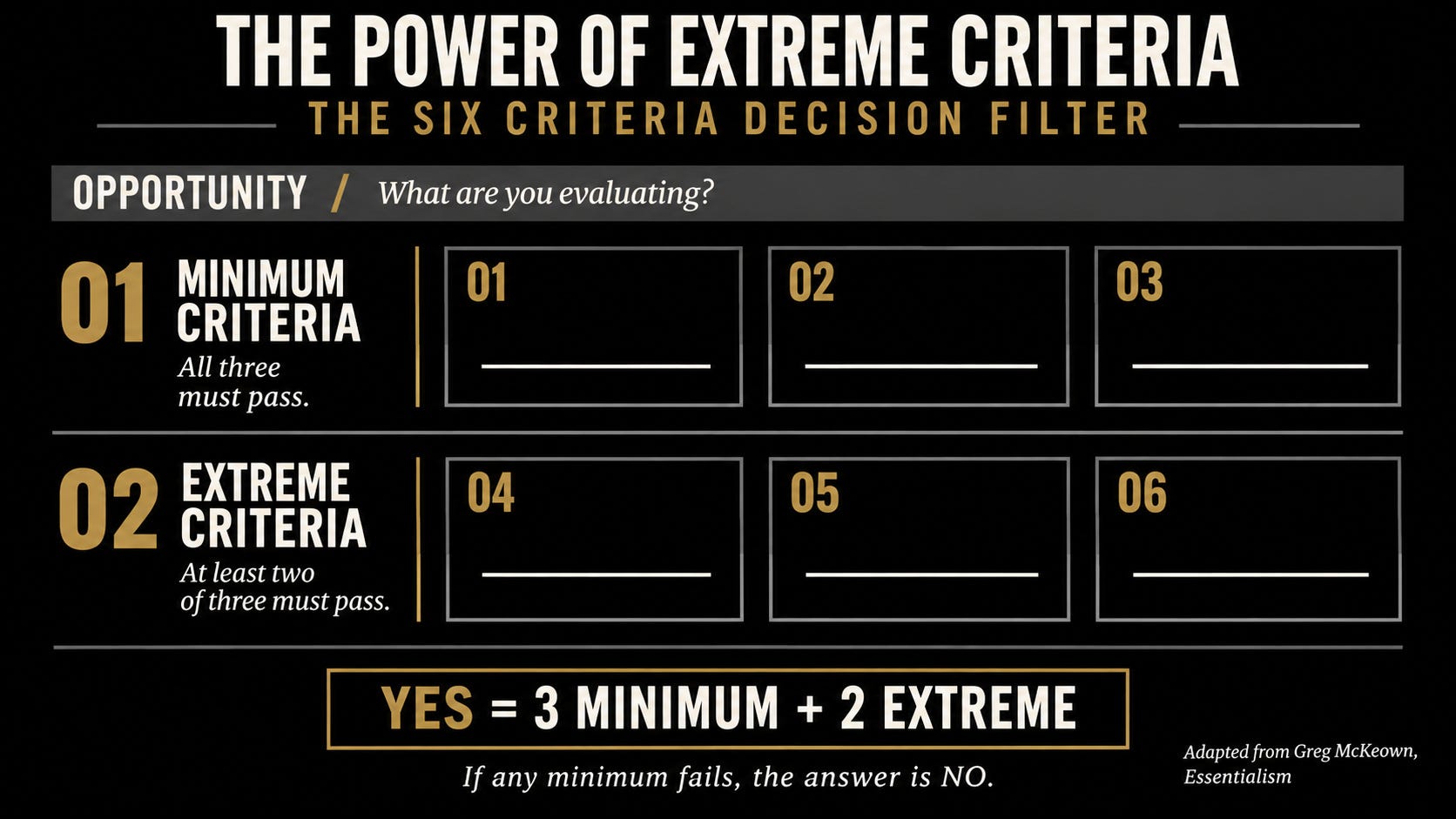
Most people evaluate an opportunity by asking whether it’s good.
But good isn’t necessarily good enough.
An opportunity can be genuinely attractive and still be a distraction from the few exceptional opportunities that deserve your full attention.
Essentially (see how I did that), this is an extension of McKeown’s 90 Percent Rule. But I’ve found that the six criteria add a more practical and visible layer to the philosophy.
They force you to establish standards before becoming emotionally attached to an opportunity.
Consider an entrepreneur evaluating a potential private equity investment.
The capital might be attractive. The valuation might exceed expectations. And the opportunity to accelerate growth might be difficult to ignore.
But what if the investment compromises something fundamental to the founder’s vision? What if the expectations around growth, control, or culture don’t align with what made the business successful in the first place?
A compelling valuation doesn’t automatically make it the right opportunity.
That’s the value of establishing your criteria before the opportunity presents itself.
And it reinforces one of McKeown’s central ideas:
If it isn’t a clear yes, then it’s a clear no.
Framework 2: The Essential Intent Formula
The second framework is one I’ve used for years in business. And the wild thing is, it’s insanely simple. But that’s precisely what makes it powerful.
McKeown introduces the idea of identifying a single essential intent that can help guide countless decisions along the way.
Verb + Population + Outcome + Date
I’ve always found traditional mission statements to lack substance.
They say so much and provide so little.
The Essential Intent Formula attempts to eliminate that ambiguity by forcing you to identify exactly what you’re doing, whom you’re doing it for, what success looks like, and when you intend to accomplish it.
The theory is simple: One sufficiently clear decision can compound over time, simplifying hundreds of smaller decisions that follow.
Here’s how the formula works.
VERB: What is it you do?
More importantly, what are you uniquely equipped to contribute? What can you do exceptionally well that creates meaningful value?
POPULATION: Who do you serve?
Who are the people you’re trying to reach, influence, or provide value to? In business, who are the customers who matter most to your purpose? In other words, who are you inviting in?
OUTCOME: What is the intended result?
What specific benefit are you trying to deliver? There may be several desirable outcomes, but what is the one that matters most?
DATE: By when will you accomplish it?
Give the outcome a defined timeline. Without one, even a well articulated intention can remain little more than an aspiration.
Four questions and a remarkably simple framework for establishing clarity around what you’re actually trying to accomplish.
Let’s make it tangible.
Imagine a youth sports performance business.
Instead of:
“Our mission is to empower athletes to reach their full potential through innovative training solutions.”
Consider:
“Develop 100 high school athletes in Charlotte, NC, through Starting Strength Barbell Fundamentals and Sport Specific Energy System Conditioning, ensuring they’re physically prepared to compete as college freshmen by December 2028.”
Here’s how that statement breaks down using the Essential Intent Formula:
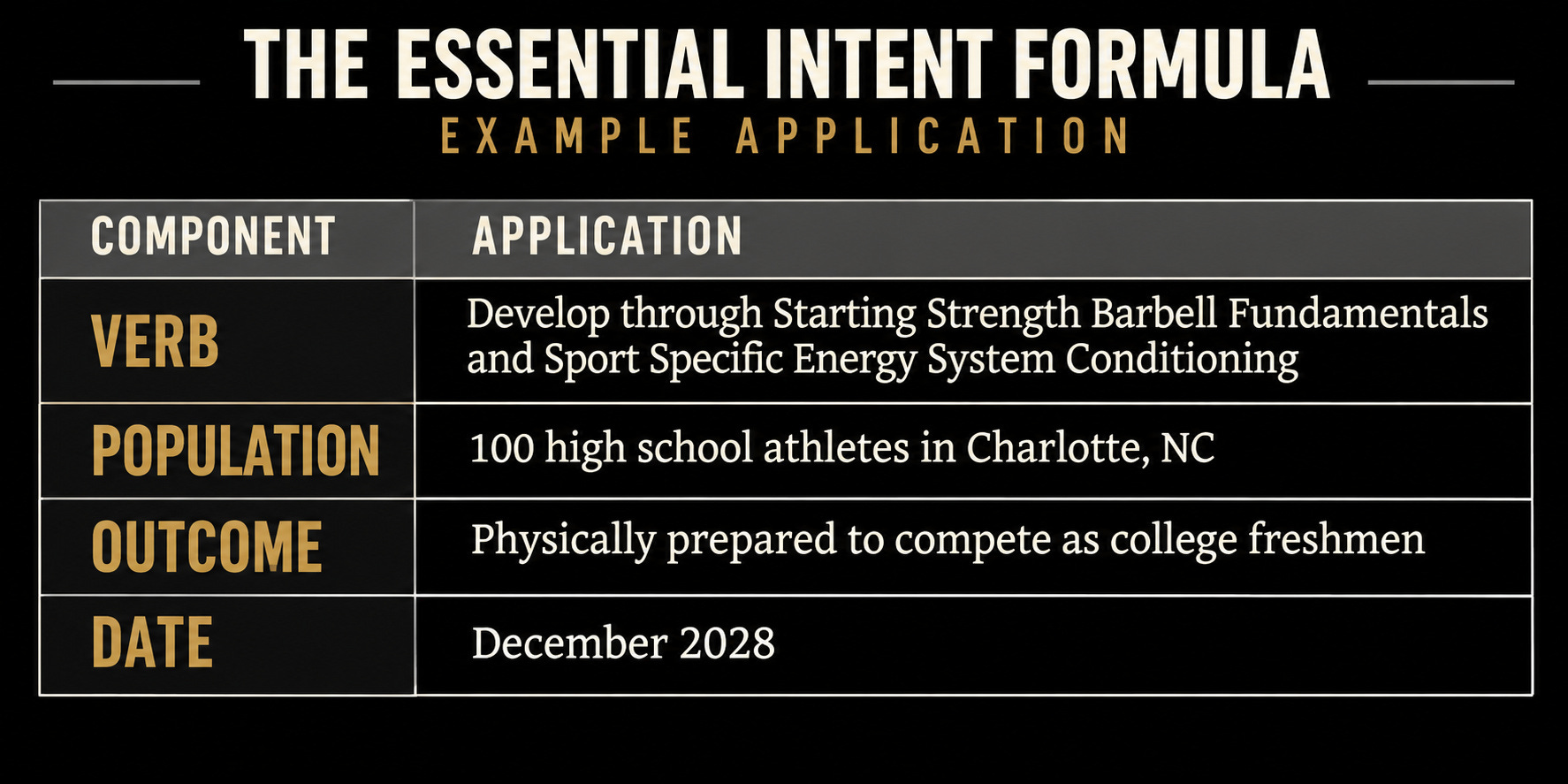
It’s less poetic.
But it gives the business, its employees, and its customers something concrete to organize around.
The goal isn’t simply to train young athletes. It’s to prepare them physically for the demands of collegiate competition, from performance testing and training camp to daily practices and the rigors of an entire season, before they even graduate high school.
There’s a defined population, a measurable outcome, and a timeline.
And perhaps most importantly, there’s a promise that can actually be evaluated.
Too many organizations waste enormous amounts of marketing dollars and manpower communicating what they aspire to become.
Far fewer take the time to define whom they intend to serve, what they’re uniquely equipped to deliver, and what success actually looks like.
There are two particularly valuable outcomes of this kind of clarity.
First, it creates internal alignment.
When everyone understands the essential intent, evaluating competing projects, budgets, hiring decisions, and opportunities becomes considerably easier.
Decisions can be measured against a shared objective rather than individual opinions or competing priorities.
Second, it creates accountability with your customers.
I’ve always believed that one of the most valuable assets a business can have is trust.
And the best way to build trust is to be upfront and honest about what you’re promising, then deliver on that promise.
The Essential Intent Formula encourages both.
Essential Before Effortless
Both frameworks come from McKeown’s first book, Essentialism.
His follow up, Effortless, builds on that philosophy by exploring how to make important work easier to execute.
And this is where I think the relationship between the two books becomes particularly interesting.
You can become exceptionally efficient at doing things that never deserved your attention in the first place.
You can build systems, improve processes, delegate responsibilities, and find countless ways to make your work easier.
But if you’re applying all that effort to the wrong things, what exactly have you accomplished?
For me, that’s the distinction.
Essentialism helps determine what matters.
Effortless helps make meaningful progress on what matters without unnecessary complexity.
And in my experience, the order is important.
You can’t make things effortless until you’ve defined what is essential.
These ideas have had a tremendous influence on how I approach business, evaluate opportunities, and make decisions in my personal life.
And the older I get, the more I appreciate that the greatest challenge isn’t necessarily finding more opportunities or accomplishing more things.
It’s developing the discipline to recognize what deserves your attention in the first place.
Because knowing what to say yes to is valuable.
Knowing what to say no to might be even more important.
Brandon Cullen
In search of life’s [im]perfect soundtrack ...