


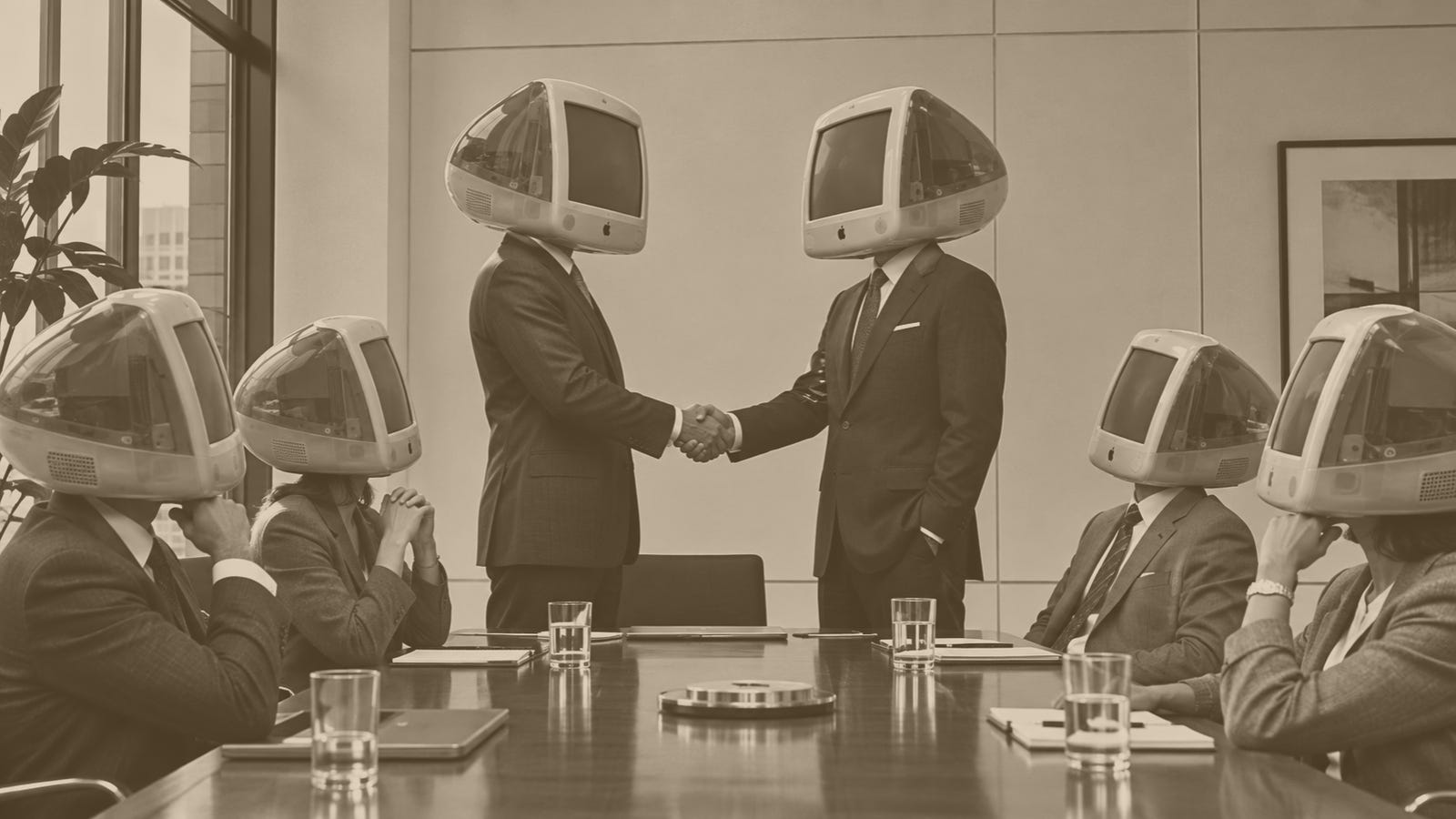
When everyone has access to the same intelligence, what makes anyone different?
I recently sat through a fascinating presentation by Ross Hartmann of Kiingo AI, titled The AI Revolution: What Comes Next.
Ninety minutes. A lot to unpack. And a few moments that genuinely blew my mind.
One prediction in particular caught my attention.
Paraphrasing Hartmann here, the assumption within his circle is that by 2030, plus or minus one year, artificial intelligence will outperform even the most capable humans across virtually every cognitive discipline.
Whether that timeline proves accurate remains to be seen. But the implications are fascinating.
And one idea stuck with me more than anything else.
AI won’t necessarily give you a competitive advantage. Eventually, it may simply become the cost of remaining competitive.
Think about that for a minute.
We’re rapidly approaching a point where access to sophisticated intelligence, research and analysis, content creation and technical expertise will no longer be particularly exclusive.
What once required specialized knowledge and substantial resources may become accessible to virtually anyone.
And while that creates extraordinary opportunities, it also brings me back to a question I’ve spent much of my professional life thinking about.
What makes one business worth choosing over another?
For years, businesses have built competitive advantages around access to information, operational efficiency, proprietary processes, and specialized expertise.
Those advantages aren’t necessarily disappearing. But the IP behind them is becoming increasingly difficult to protect.
A competitor may soon be able to replicate your processes, produce comparable content, analyze the same market, and access much of the same intelligence.
And those heavily funded will be able to acquire specialized expertise, combine it with these emerging capabilities, and potentially do it all faster and cheaper.
This is where I think the conversation becomes particularly interesting.
While technology can democratize intelligence, it doesn’t automatically create trust, reputation, or a sense of belonging.
It can’t offer firsthand experience or possess an instinct for cultural relevance beyond the aggregate of information it’s been exposed to. It certainly can’t manufacture a meaningful point of view. And perhaps most importantly, it can’t build genuine human relationships.
Those qualities are developed through experience and exposure. Through the curiosity to make mistakes and the willingness to make decisions that live outside of the aggregate.
They’re also fundamental to something I’ve always believed separates exceptional brands from forgettable ones.
Positioning.
Not logos, mission statements, or Pantones.
Positioning.
The discipline of understanding who you are, who you’re for, what you believe, and why anyone should pay attention.
Having access to the same information doesn’t mean two people will interpret it the same way. This has been true throughout history.
And simply having the ability to produce something doesn’t necessarily mean you understand whether it belongs in your business in the first place.
That’s the difference between having the capability and having a genuine point of view.
AI can help you understand a market. It can’t independently establish what your business should stand for.
It can identify trends, but assuming they’re all worth following would be ignorant.
And it can produce an extraordinary amount of content without giving anyone a compelling reason to care.
If anything, an increasingly crowded marketplace makes distinction more important.
Trust is earned through consistency.
Reputation is built through actions.
Belonging comes from a genuine understanding of a particular group of people.
Behind it all is a distinct point of view. The ability to see things differently and build a business around that perspective rather than simply following what everyone else is doing.
Perspective becomes an advantage.
These are the things I suspect will become increasingly difficult to replicate, regardless of how sophisticated technology becomes.
How you do business becomes a new form of IP.
This is especially interesting when applied to niche businesses. The brave ones that have never attempted to appeal to everyone. The ones built around a particular philosophy, aesthetic, or shared set of beliefs.
Their advantage isn’t necessarily that they know something nobody else knows. And as we’ve established, that kind of advantage may become increasingly difficult to protect.
No, I think it’s much simpler than that.
It’s that they see something differently. And they’re willing to build around it.
I’ve long believed that the most compelling brands aren’t necessarily the ones with the greatest resources. They are the ones with the clearest sense of identity.
They understand their audience intimately. They know what belongs and, perhaps more importantly, what doesn’t. And they build everything around that understanding.
Over time, these brands develop something considerably harder to replicate than content, software, or operational efficiency.
Trust. Reputation. Belonging.
AI agents might be able to build your website, develop your marketing strategy, analyze your competitors, and optimize your business.
Actually, AI agents WILL be able to build your website, develop your marketing strategy, analyze your competitors, and optimize your business.
But none of that guarantees anyone will care about what you’ve built.
And as the technical barriers to building businesses continue to fall, I suspect the human qualities behind exceptional brands will become more valuable, not less.
Because when everyone has access to the same intelligence, the advantage may no longer be what you know, but how you choose to distinguish yourself with it.
Brandon Cullen
In search of life’s [im]perfect soundtrack ...
AI is making it easier than ever to build things. Unfortunately, it doesn't make people any better at deciding what's worth building. I actually wrote about this in my own Substack recently. I suspect we're about to see a lot more businesses that are technically impressive and completely forgettable.